What Exercises Burn the Most Calories
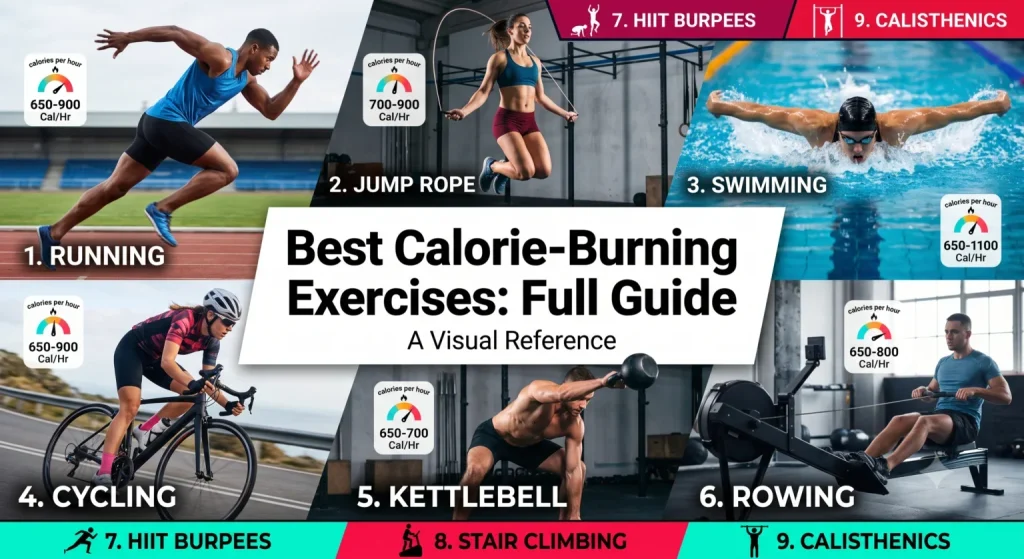
Jump rope, fast running, vigorous cycling, swimming and rowing burn the most calories, roughly 550 to 850 per hour for a 70 kg person. Your own number depends on your weight and how hard you push. Below, you will find 12 exercises ranked by calorie burn, low-impact options for sore joints, quick bodyweight moves for busy days, and two simple routines you can start this week.
Some workouts burn calories fast but are hard on your joints. Others burn steadily and are easy to repeat for years. This guide ranks the most effective calorie-burning exercises, shows you how to estimate your own numbers, and gives you two ready-made routines to start this week.
What Decides How Many Calories You Burn
Two people can do the same workout and burn very different amounts. Several things explain the gap.
Body weight matters most: a heavier body needs more energy to move, so it burns more calories doing the same activity. Intensity comes next, because working harder burns far more per minute than taking the same exercise easy, and duration multiplies that, since the longer you keep going, the higher your total.
Muscle mass plays a smaller role than most people think, although muscle does use more energy at rest than fat. Fitness level matters too. As you get fitter, your body becomes more efficient, so the same workout may burn slightly fewer calories over time. That is a sign of progress, not a problem.
How to Estimate Your Own Calorie Burn
Exercise intensity is measured in METs (metabolic equivalents). A simple estimate is:
Calories per hour ≈ MET value × body weight in kg
For example, jogging at about 10 km/h is roughly 10 METs. At 70 kg that is about 700 calories per hour, and at 90 kg it is about 900. MET values for hundreds of activities are published in the Compendium of Physical Activities, which is the source most fitness calculators rely on.
Fitness trackers and gym machines use similar math plus heart rate, but they are still estimates. Use them to compare your own workouts over time rather than as exact numbers. For a full-day picture that includes your resting metabolism, see our guide on how many calories you burn in a day.
Calories Burned Per Hour: Top Exercises Ranked
The figures below are for a person weighing about 70 kg (154 lb) working at moderate to vigorous effort. If you weigh more, expect higher numbers. If you weigh less, expect lower ones.

Use this table to compare exercises with each other. Your real numbers will depend on your weight and how hard you actually push.
| Exercise | Approximate Calories Burned Per Hour |
| Running (fast pace, ~10km/h) | 700-900 |
| Jumping Rope | 700-900 |
| Swimming (vigorous laps) | 600-750 |
| Rowing (vigorous) | 600-750 |
| Cycling (vigorous) | 550-750 |
| HIIT / Circuit Training | 500-700 |
| Running (moderate jog) | 500-650 |
| Strength Training (continuous) | 350-500 |
| Swimming (moderate) | 400-500 |
| Cycling (moderate) | 350-500 |
| Brisk Walking | 250-350 |
| Yoga (active/vinyasa style) | 200-350 |
Use this table to compare exercises with each other. Your real numbers will depend on your weight and how hard you actually push.
Best Cardio Exercises for Burning Calories

Running needs nothing but a good pair of shoes, and you can raise the burn instantly with faster pace, sprint intervals or hills. Trail running adds uneven terrain, which makes your stabilizing muscles work harder than a flat treadmill does.
Jumping rope takes very little space and spikes your heart rate quickly. Ten hard minutes can match the effort of a fast run. Start with short rounds, because the calves and ankles need time to adapt.
Cycling lets you work hard for a long time with much less joint stress than running. Outdoor hills or a spin class load the quads and glutes heavily, which drives a high and steady burn.
Swimming uses your arms, back, core and legs together, and the water supports your body weight. That makes it a strong option if you have knee or hip problems or are recovering from an injury.
Rowing is often underrated. Each stroke combines a leg drive, a core brace and a pull with the back and arms, so almost every major muscle group works at once.
Does Strength Training Burn Calories Too?

A strength session usually burns fewer calories than hard cardio in the same time. Its value shows up in other ways.
After a hard session your body does burn a little extra energy while it recovers (the afterburn effect, or EPOC), but the effect is modest, usually a small fraction of what the workout itself burned. Muscle also uses energy at rest, roughly 6 calories per day for each pound (about 13 per kg). Building muscle helps, although it adds up slowly.
The bigger benefits are practical. When you eat less to lose weight, lifting helps you keep muscle, so more of the weight you lose is fat. A mix of cardio and strength also tends to work better for weight management than cardio alone, and it supports your bones and joints. If you do not have a gym, our guide to building muscle without lifting weights shows what you can do at home.
Quick Bodyweight Moves for a Time Crunch

When you only have 10 minutes, a few moves raise your heart rate fast without any equipment.
For high knees, run in place while driving your knees up toward your chest. Butt kicks are the same jog, but you kick your heels back toward your glutes. For mountain climbers, start in a plank position and drive your knees toward your chest, alternating legs.
At a hard pace, a 70 kg person burns roughly 8–12 calories per minute doing these. That is about 80–120 calories in 10 minutes, but only if you keep the effort high. You cannot hold that pace for an hour, which is why these moves suit short bursts rather than long sessions.
Low-Impact Exercises That Still Burn Serious Calories

Low impact does not mean low burn. If you have joint pain, are returning from injury, or simply prefer gentler workouts, these are good choices.
Swimming and water aerobics take most of the load off your joints because of water buoyancy, while the water gives constant resistance. Cycling works the same way: raise the resistance or climb hills and you get a hard workout with no pounding.
The elliptical copies a running stride with your feet planted, and the moving handles bring your upper body in. Incline walking at 5–6 km/h on a 5–12% slope works your legs far harder than flat walking and can approach the effort of an easy jog, with much less impact. You can estimate your own walking burn with our Walking Calorie Calculator.
Two Sample Routines to Start With
20-minute beginner circuit (no equipment)
Warm up for 4 minutes with easy marching and arm circles. Then do four rounds of four moves, working for 40 seconds and resting for 20 seconds between each: fast marching or high knees, bodyweight squats, mountain climbers (with your hands on a sofa or bench if you are a beginner), and glute bridges.
Finish with a few minutes of gentle stretching. Expect roughly 120–180 calories depending on your weight and effort.
Low-impact week
Start the week with 30–40 minutes of incline walking on Monday and a 30-minute strength session on Tuesday. On Wednesday, swim or cycle for 30 minutes, then take Thursday as a rest day or an easy walk. Repeat strength training on Friday, do 40 minutes of cycling or the elliptical on Saturday, and rest on Sunday.
Diet or Exercise: Which Matters More for Weight Loss?
For weight loss, diet usually has the bigger impact, because it is much easier to skip 800 calories than to burn them. A large fast-food meal can reach 800–1,000 calories, and burning that off can take close to an hour of hard exercise. That does not make exercise pointless. It protects muscle, heart health and long-term weight maintenance. The best results come from a reasonable calorie deficit combined with regular movement. If weight loss is your main goal, our guide to the best workout for weight loss and our list of low-calorie foods for weight loss are good next steps.
To find your daily calorie needs, try our free Calorie Calculator. The Maintenance Calories Calculator shows how much you can eat to hold your current weight, and the Food Calories Calculator helps you check what is on your plate.
How to Get Started Safely
Combine cardio and strength training rather than choosing only one. Warm up and cool down with 5-10 minutes of light movement before and after your workout to lower injury risk. Start at a sustainable intensity, especially if you’re new or returning after time off, and build up gradually over a few weeks. Listen to your body some fatigue is normal, but sharp pain, dizziness, or unusual shortness of breath are signs to stop and check in with a doctor if needed.
Final Thoughts
Running, jumping rope, cycling, swimming and rowing burn the most calories per hour, while short bodyweight circuits help when time is tight. Strength training adds less burn in the moment but protects the muscle that keeps your metabolism healthy. The best calorie-burning exercise is the one you can do safely and keep doing consistently.
This article is for general information only and is not medical advice. Please consult a doctor, dietitian or qualified fitness professional before changing your diet or exercise routine.
Frequently Asked Questions
Jumping rope and sprinting are generally the fastest calorie burners per minute, each capable of burning around 15-20 calories per minute at a fast, intense pace. High-knee running and mountain climbers come close behind, making them great options when you only have a few minutes to spare.
Running at a fast pace (around 10km/h), jumping rope continuously, vigorous swimming, or intense rowing can all burn approximately 700 calories in an hour, depending on your body weight and effort level. Heavier individuals or those pushing a higher intensity will typically burn toward the higher end of this range, while lighter or less intense effort will land closer to the lower end.
Burning 3,000 calories in a single day through exercise alone is extremely demanding and generally not realistic or necessary for most people — it would require several hours of intense activity on top of your body’s normal daily calorie burn from resting metabolism. A more realistic approach combines your body’s natural calorie burn (often 1,800-2,500+ calories per day on its own) with a reasonable amount of exercise, rather than trying to burn an extreme amount through workouts alone.
Burning 600 calories in just 30 minutes requires very high intensity and is more achievable for larger or highly conditioned individuals — fast running, vigorous rowing, intense HIIT circuits, or hard cycling can reach this range for some people, though many will burn somewhat less in the same time. If this feels out of reach, that’s completely normal; extending the same workout to 45-60 minutes at a sustainable pace is a more realistic way to reach a similar total burn.
Pair Your Workouts With the Right Nutrition
Get your personalized daily calorie target to match your activity level.
Was This Article Helpful?
Your feedback helps us improve our content. This form is not connected to customer support — for questions, please visit our Contact Us page.
Related Articles

Best Workout for Weight Loss
Discover how to structure cardio and strength routines for optimal fat loss and maximum efficiency.
Read Guide →
How to Build Muscle Without Lifting Weights
Learn effective bodyweight and calisthenics progressions to build real muscle strength at home.
Read Guide →
Explore More Articles
Browse our full collection of evidence-based fitness, nutrition, and health calculators and guides.
View All Articles →